Microsoft AZ-104 - Microsoft Azure Administrator Exam Certification Examination Exam
Question #1 (Topic: demo questions)
HOTSPOT
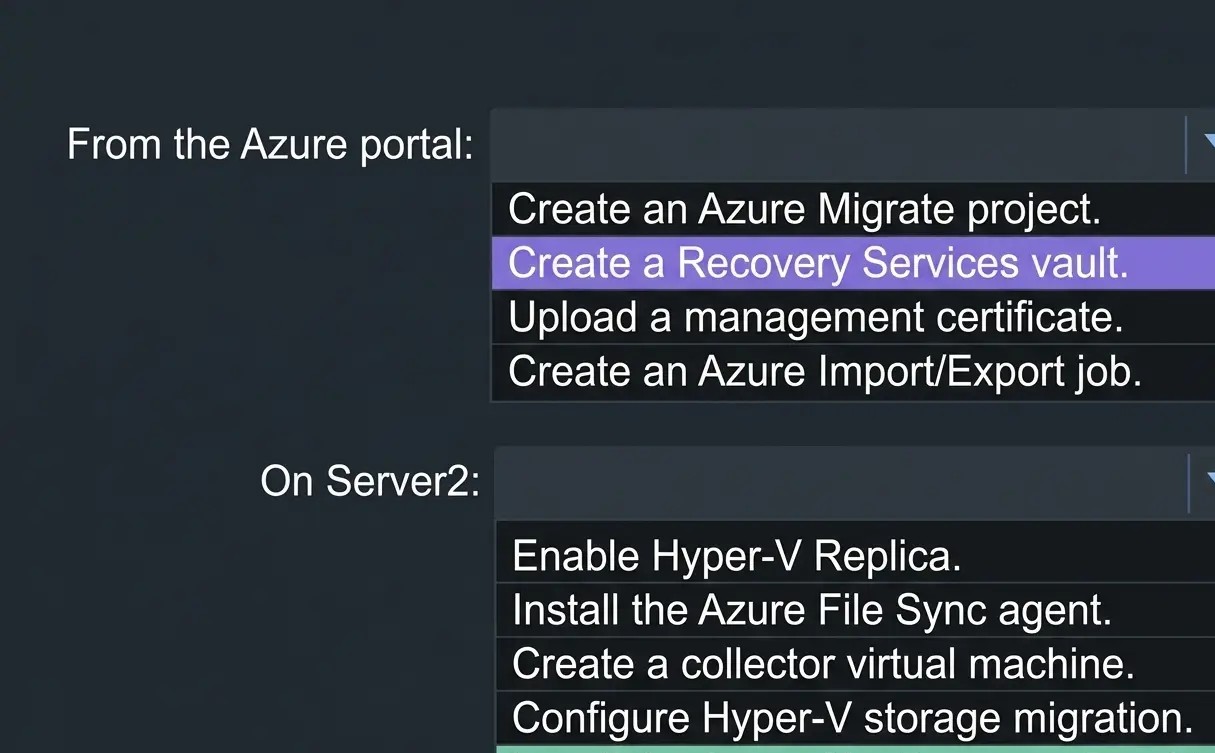
You need to the appropriate sizes for the Azure virtual for Server2.
What should you do? To answer, select the appropriate options in the answer area.
NOTE: Each correct selection is worth one point.
A.
Correct Answer: A
Explanation:
Box 1: Create a Recovery Services vault
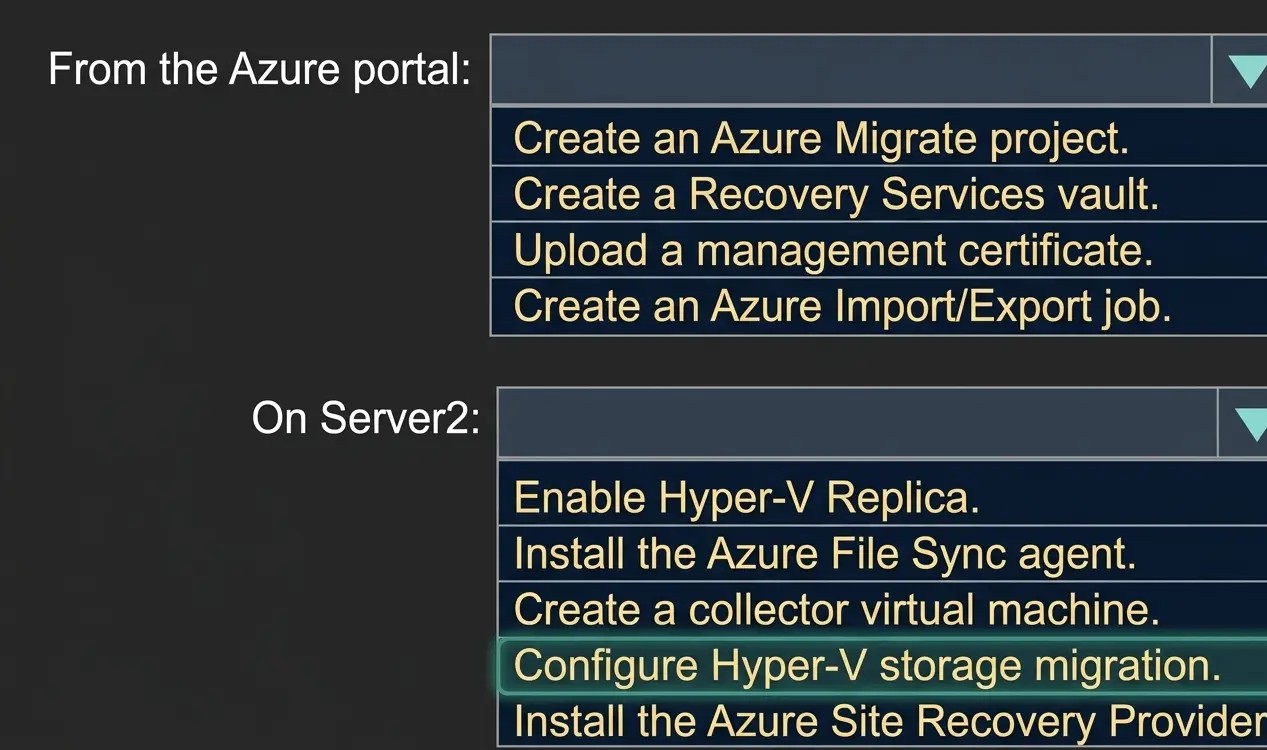
Box 1: Create a Recovery Services vault
Create a Recovery Services vault on the Azure Portal.
Box 2: Install the Azure Site Recovery Provider
Azure Site Recovery can be used to manage migration of on-premises machines to Azure.
Scenario: Migrate the virtual machines hosted on Server1 and Server2 to Azure.
Server2 has the Hyper-V host role.
Reference:
https://docs.microsoft.com/en-us/azure/site-recovery/migrate-tutorial-on-premises-azure
Question #2 (Topic: demo questions)
HOTSPOT
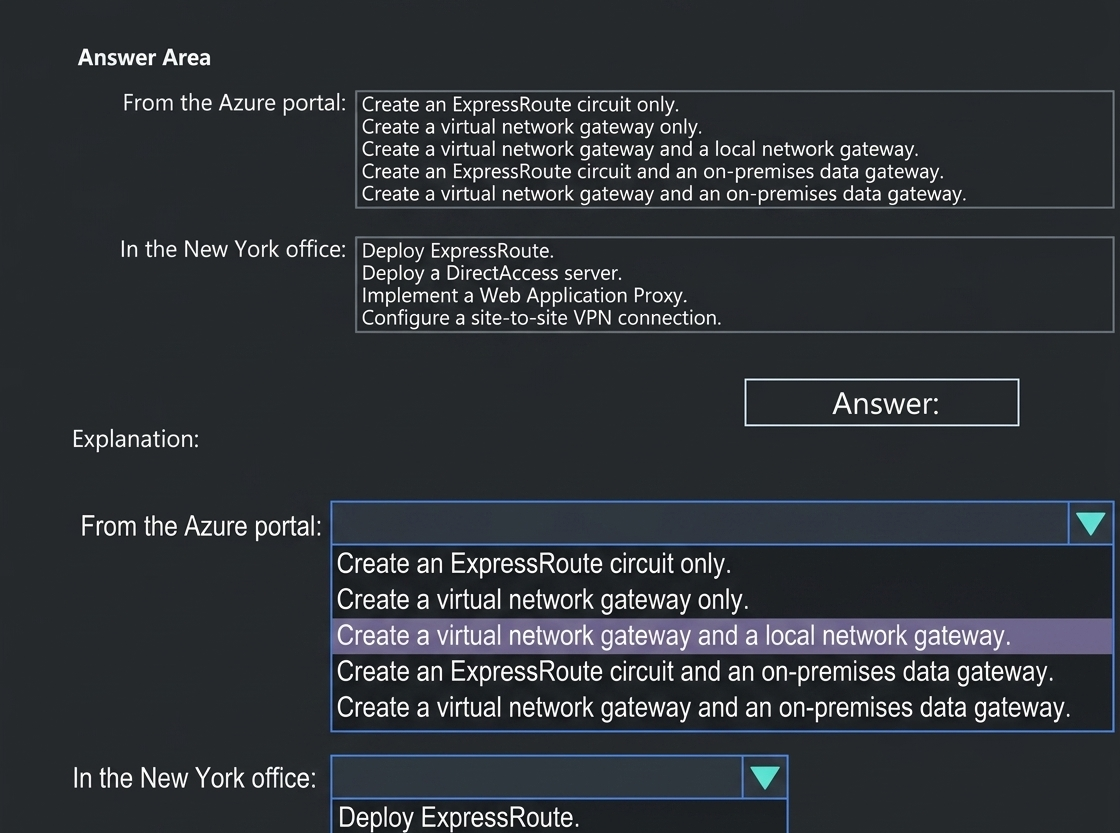
You need to meet the connection requirements for the New York office.
What should you do? To answer, select the appropriate options in the answer area.
NOTE: Each correct selection is worth one point.
A.
Correct Answer: A
Explanation:
Box 1: Create a virtual network gateway and a local network gateway.
Box 1: Create a virtual network gateway and a local network gateway.
Azure VPN gateway. The VPN gateway service enables you to connect the VNet to the on-premises
network through a VPN appliance. For more information, see Connect an on-premises network to a
Microsoft Azure virtual network. The VPN gateway includes the following elements:
Virtual network gateway. A resource that provides a virtual VPN appliance for the VNet. It is
responsible for routing traffic from the on-premises network to the VNet.
Local network gateway. An abstraction of the on-premises VPN appliance. Network traffic from the
cloud application to the on-premises network is routed through this gateway.
Connection. The connection has properties that specify the connection type (IPSec) and the key
shared with the on-premises VPN appliance to encrypt traffic.
Gateway subnet. The virtual network gateway is held in its own subnet, which is subject to various
requirements, described in the Recommendations section below.
Box 2: Configure a site-to-site VPN connection
On premises create a site-to-site connection for the virtual network gateway and the local network
gateway
Question #3 (Topic: demo questions)
You discover that VM3 does NOT meet the technical requirements.
You need to verify whether the issue relates to the NSGs.
What should you use?
Correct Answer: E
Explanation:
Scenario: Litware must meet technical requirements including:
Scenario: Litware must meet technical requirements including:
Ensure that VM3 can establish outbound connections over TCP port 8080 to the applications servers
in the Montreal office.
IP flow verify checks if a packet is allowed or denied to or from a virtual machine. The information
consists of direction, protocol, local IP, remote IP, local port, and remote port. If the packet is denied
by a security group, the name of the rule that denied the packet is returned. While any source or
destination IP can be chosen, IP flow verify helps administrators quickly diagnose connectivity issues
from or to the internet and from or to the on-premises environment.
Reference:
https://docs.microsoft.com/en-us/azure/network-watcher/network-watcher-ip-flow-verify-overview
Question #4 (Topic: demo questions)
You need to ensure that VM1 can communicate with VM4. The solution must minimize
administrative effort.
What should you do?
Correct Answer: B
Explanation:
Question #5 (Topic: demo questions)
HOTSPOT
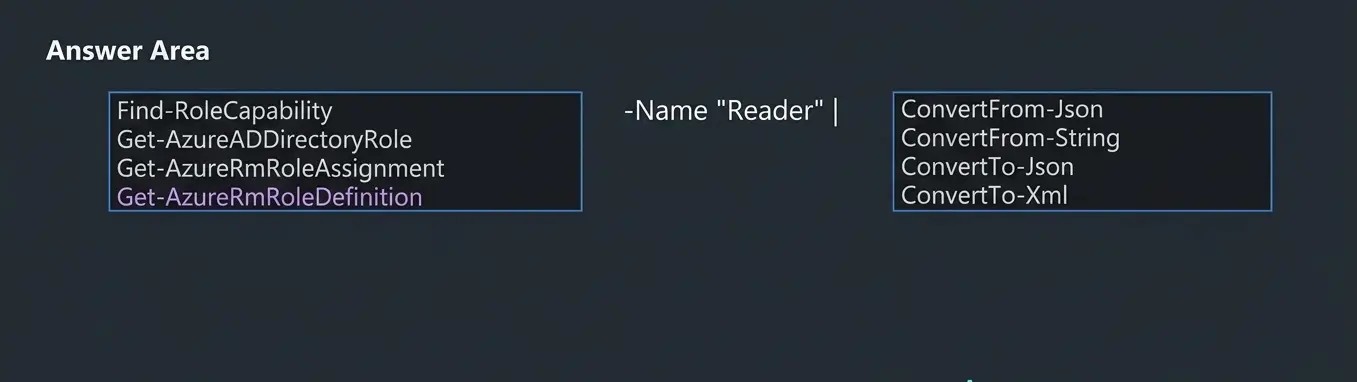
You need to implement Role1.
Which command should you run before you create Role1? To answer, select the appropriate options
in the answer area.
NOTE: Each correct selection is worth one point.
A.
Correct Answer: A
Explanation not available for this question.